Protein Molecular Weight Markers
- (1)
- (1)
- (1)
- (1)
- (1)
- (39)
- (2)
- (19)
- (1)
- (2)
- (1)
- (1)
- (2)
- (2)
- (1)
- (1)
- (2)
- (2)
- (1)
- (2)
- (2)
- (1)
- (4)
- (1)
- (1)
- (1)
- (1)
- (1)
- (2)
- (3)
- (3)
- (1)
- (1)
- (2)
- (2)
- (1)
- (1)
- (2)
- (4)
- (2)
- (1)
- (1)
- (1)
- (4)
- (1)
- (2)
- (3)
- (1)
- (1)
- (2)
- (3)
- (13)
- (1)
- (3)
- (2)
- (5)
- (3)
- (2)
- (9)
- (3)
- (5)
- (2)
- (1)
- (1)
- (3)
- (2)
- (9)
- (9)
- (1)
- (7)
- (2)
- (1)
- (2)
- (2)
- (3)
- (1)
- (24)
Filtered Search Results
ABclonal Technology [KO Validated] CRMP2/DPYSL2 Rabbit pAb
Small and Specialty Supplier Partner
Small and/or specialty supplier based on Federal laws and SBA requirements.
Learn More
Small and/or specialty supplier based on Federal laws and SBA requirements.
Learn More
This gene encodes a member of the collapsin response mediator protein family. Collapsin response mediator proteins form homo- and hetero-tetramers and facilitate neuron guidance, growth and polarity. The encoded protein promotes microtubule assembly and is required for Sema3A-mediated growth cone collapse, and also plays a role in synaptic signaling through interactions with calcium channels. This gene has been implicated in multiple neurological disorders, and hyperphosphorylation of the encoded protein may play a key role in the development of Alzheimers disease. Alternatively spliced transcript variants encoding multiple isoforms have been observed for this gene.
Non-distribution item offered as a customer accommodation; additional freight charges may apply.
Learn More
ABclonal Technology LysRS/KARS Rabbit mAb
Small and Specialty Supplier Partner
Small and/or specialty supplier based on Federal laws and SBA requirements.
Learn More
Small and/or specialty supplier based on Federal laws and SBA requirements.
Learn More
Aminoacyl-tRNA synthetases are a class of enzymes that charge tRNAs with their cognate amino acids. Lysyl-tRNA synthetase is a homodimer localized to the cytoplasm which belongs to the class II family of tRNA synthetases. It has been shown to be a target of autoantibodies in the human autoimmune diseases, polymyositis or dermatomyositis. Alternatively spliced transcript variants encoding different isoforms have been found for this gene.
Non-distribution item offered as a customer accommodation; additional freight charges may apply.
Learn More
ABclonal Technology KCNJ12 Rabbit pAb
Small and Specialty Supplier Partner
Small and/or specialty supplier based on Federal laws and SBA requirements.
Learn More
Small and/or specialty supplier based on Federal laws and SBA requirements.
Learn More
This gene encodes an inwardly rectifying K+ channel which may be blocked by divalent cations. This protein is thought to be one of multiple inwardly rectifying channels which contribute to the cardiac inward rectifier current (IK1). The gene is located within the Smith-Magenis syndrome region on chromosome 17.
Non-distribution item offered as a customer accommodation; additional freight charges may apply.
Learn More
ABclonal Technology IQGAP2 Rabbit pAb
Small and Specialty Supplier Partner
Small and/or specialty supplier based on Federal laws and SBA requirements.
Learn More
Small and/or specialty supplier based on Federal laws and SBA requirements.
Learn More
This gene encodes a member of the IQGAP family. The encoded protein contains three IQ domains, one calponin homology domain, one Ras-GAP domain and one WW domain. This protein interacts with components of the cytoskeleton, with cell adhesion molecules, and with several signaling molecules to regulate cell morphology and motility. It also acts as a tumor suppressor and has been found to play a role in regulating innate antiviral responses. Alternative splicing results in multiple transcript variants.
Non-distribution item offered as a customer accommodation; additional freight charges may apply.
Learn More
ABclonal Technology ZDHHC18 Rabbit pAb
Small and Specialty Supplier Partner
Small and/or specialty supplier based on Federal laws and SBA requirements.
Learn More
Small and/or specialty supplier based on Federal laws and SBA requirements.
Learn More
Enables palmitoyltransferase activity. Involved in peptidyl-L-cysteine S-palmitoylation. Located in Golgi apparatus.
Non-distribution item offered as a customer accommodation; additional freight charges may apply.
Learn More
ABclonal Technology CHRM3 Rabbit pAb
Small and Specialty Supplier Partner
Small and/or specialty supplier based on Federal laws and SBA requirements.
Learn More
Small and/or specialty supplier based on Federal laws and SBA requirements.
Learn More
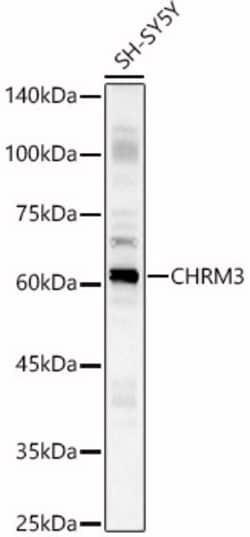
The muscarinic cholinergic receptors belong to a larger family of G protein-coupled receptors. The functional diversity of these receptors is defined by the binding of acetylcholine and includes cellular responses such as adenylate cyclase inhibition, phosphoinositide degeneration, and potassium channel mediation. Muscarinic receptors influence many effects of acetylcholine in the central and peripheral nervous system. The muscarinic cholinergic receptor 3 controls smooth muscle contraction and its stimulation causes secretion of glandular tissue. Alternative promoter use and alternative splicing results in multiple transcript variants that have different tissue specificities.
Non-distribution item offered as a customer accommodation; additional freight charges may apply.
Learn More
ABclonal Technology FUNDC1 Rabbit pAb
Small and Specialty Supplier Partner
Small and/or specialty supplier based on Federal laws and SBA requirements.
Learn More
Small and/or specialty supplier based on Federal laws and SBA requirements.
Learn More
This gene encodes a protein with a FUN14 superfamily domain. The function of the encoded protein is not known.
Non-distribution item offered as a customer accommodation; additional freight charges may apply.
Learn More
ABclonal Technology ARMC6 Rabbit pAb
Small and Specialty Supplier Partner
Small and/or specialty supplier based on Federal laws and SBA requirements.
Learn More
Small and/or specialty supplier based on Federal laws and SBA requirements.
Learn More
The function of this genes protein product has not been determined. A related protein in mouse suggests that this protein has a conserved function. Two transcript variants encoding different isoforms have been found for this gene.
Non-distribution item offered as a customer accommodation; additional freight charges may apply.
Learn More
ABclonal Technology S100A5 Rabbit pAb
Small and Specialty Supplier Partner
Small and/or specialty supplier based on Federal laws and SBA requirements.
Learn More
Small and/or specialty supplier based on Federal laws and SBA requirements.
Learn More
The protein encoded by this gene is a member of the S100 family of proteins containing 2 EF-hand calcium-binding motifs. S100 proteins are localized in the cytoplasm and/or nucleus of a wide range of cells, and involved in the regulation of a number of cellular processes such as cell cycle progression and differentiation. S100 genes include at least 13 members which are located as a cluster on chromosome 1q21. This protein has a Ca2+ affinity 20- to 100-fold higher than the other S100 proteins studied under identical conditions. This protein also binds Zn2+ and Cu2+, and Cu2+ strongly which impairs the binding of Ca2+. This protein is expressed in very restricted regions of the adult brain.
Non-distribution item offered as a customer accommodation; additional freight charges may apply.
Learn More
ABclonal Technology ADAM28 Rabbit pAb
Small and Specialty Supplier Partner
Small and/or specialty supplier based on Federal laws and SBA requirements.
Learn More
Small and/or specialty supplier based on Federal laws and SBA requirements.
Learn More
This gene encodes a member of the ADAM (a disintegrin and metalloprotease domain) family. Members of this family are membrane-anchored proteins structurally related to snake venom disintegrins, and have been implicated in a variety of biological processes involving cell-cell and cell-matrix interactions, including fertilization, muscle development, and neurogenesis. The protein encoded by this gene is a lymphocyte-expressed ADAM protein. This gene is present in a gene cluster with other members of the ADAM family on chromosome 8. Alternative splicing results in multiple transcript variants.
Non-distribution item offered as a customer accommodation; additional freight charges may apply.
Learn More
ABclonal Technology CFHR5 Rabbit pAb
Small and Specialty Supplier Partner
Small and/or specialty supplier based on Federal laws and SBA requirements.
Learn More
Small and/or specialty supplier based on Federal laws and SBA requirements.
Learn More
This gene is a member of a small complement factor H (CFH) gene cluster on chromosome 1. Each member of this gene family contains multiple short consensus repeats (SCRs) typical of regulators of complement activation. The protein encoded by this gene has nine SCRs with the first two repeats having heparin binding properties, a region within repeats 5-7 having heparin binding and C reactive protein binding properties, and the C-terminal repeats being similar to a complement component 3 b (C3b) binding domain. This protein co-localizes with C3, binds C3b in a dose-dependent manner, and is recruited to tissues damaged by C-reactive protein. Allelic variations in this gene have been associated, but not causally linked, with two different forms of kidney disease membranoproliferative glomerulonephritis type II (MPGNII) and hemolytic uraemic syndrome (HUS).
Non-distribution item offered as a customer accommodation; additional freight charges may apply.
Learn More
ABclonal Technology 14-3-3 sigma Rabbit pAb
Small and Specialty Supplier Partner
Small and/or specialty supplier based on Federal laws and SBA requirements.
Learn More
Small and/or specialty supplier based on Federal laws and SBA requirements.
Learn More
This gene encodes a cell cycle checkpoint protein. The encoded protein binds to translation and initiation factors and functions as a regulator of mitotic translation. In response to DNA damage this protein plays a role in preventing DNA errors during mitosis.
Non-distribution item offered as a customer accommodation; additional freight charges may apply.
Learn More
ABclonal Technology ARFRP1 Rabbit pAb
Small and Specialty Supplier Partner
Small and/or specialty supplier based on Federal laws and SBA requirements.
Learn More
Small and/or specialty supplier based on Federal laws and SBA requirements.
Learn More
The protein encoded by this gene is a membrane-associated GTP-ase which localizes to the plasma membrane and is related to the ADP-ribosylation factor (ARF) and ARF-like (ARL) proteins. This gene plays a role in membrane trafficking between the trans-Golgi network and endosomes. Alternatively spliced transcript variants encoding different isoforms have been identified.
Non-distribution item offered as a customer accommodation; additional freight charges may apply.
Learn More
ABclonal Technology INCENP Rabbit pAb
Small and Specialty Supplier Partner
Small and/or specialty supplier based on Federal laws and SBA requirements.
Learn More
Small and/or specialty supplier based on Federal laws and SBA requirements.
Learn More
In mammalian cells, centromere-interacting proteins are classified into two groups: constitutive and passenger proteins. Constitutive proteins, which bind centromere proteins, include CENPA, CENPB, CENPC1, and CENPD. Passenger proteins localize to the centromere during specific cell cycle stages and include CENPE, MCAK, KID, cytoplasmic dynein, CliPs, and CENPF/mitosin. Inner centromere proteins (INCENPs), early members of the passenger protein group, are broadly distributed along chromosomes in early mitosis but concentrate at centromeres during mid-metaphase. By telophase, they localize to the midbody in the intercellular bridge and are discarded after cytokinesis.
Non-distribution item offered as a customer accommodation; additional freight charges may apply.
Learn More
ABclonal Technology SEC24D Rabbit pAb
Small and Specialty Supplier Partner
Small and/or specialty supplier based on Federal laws and SBA requirements.
Learn More
Small and/or specialty supplier based on Federal laws and SBA requirements.
Learn More
The protein encoded by this gene is a member of the SEC24 subfamily of the SEC23/SEC24 family, which is involved in vesicle trafficking. The encoded protein has similarity to yeast Sec24p component of COPII. COPII is the coat protein complex responsible for vesicle budding from the ER. This gene product is implicated in the shaping of the vesicle, and also in cargo selection and concentration. Mutations in this gene have been associated with Cole-Carpenter syndrome, a disorder affecting bone formation, resulting in craniofacial malformations and bones that break easily. Alternative splicing results in multiple transcript variants encoding different isoforms.
Non-distribution item offered as a customer accommodation; additional freight charges may apply.
Learn More